

 The Tennessee Valley Authority: Design and Persuasion (New York: Princeton Architectural Press, 2007) explores design’s role in promoting the United States’ most extensive regional planning endeavor. Following my introduction, essays explore the several design disciplines that were united in the effort: Christine Macy writes on architecture, Jane Wolff on landscape architecture, Barry Katz on industrial design, Steven Heller on graphic design, Todd Smith on mural painting. Jennifer Bloomer reflects on rural life in the Tennessee Valley, before and after the work of the TVA, and the volume concludes with an afterword by Senator Howard H. Baker, Jr. 2008 marks the 75th anniversary of the TVA.
Illustrations include both archival photographs and new photographs by Richard Barnes, including those below. (Click on an image to enlarge.)
Download the Introduction to “The Tennessee Valley Authority: Design & Persuasion”
The 1%
 The 1% program of Public Architecture challenges architecture and design firms nationwide to pledge a minimum of 1% of their time to pro bono service. The 1% connects firms willing to give of their time with nonprofit organizations in need of design assistance.
Rivers Make Lines
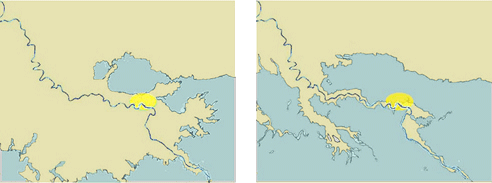 A map of southern Louisiana, modified as if sea level were a mere one foot higher than it actually is, suggests the natural form of cities along the lower Mississippi.* Naturally, they are linear. Rebuilt as an essentially linear city, New Orleans could become one of the few cities in North America where light-rail transit actually works.
We might expect denser development uptown in the band between Magazine Street and the river, with nodes of activity at the foot of each of the major radial streets — Jackson, Louisiana, Napoleon, Nashville, and so on. A light-rail route along the existing railroad right-of-way at the river could merge seamlessly into a regional storm evacuation network.
* These maps are derived from more precise maps, based on satellite imagery, developed by Richard Campanella in his extraordinary Time and Place in New Orleans: Past Geographies in the Present Day (Gretna: Pelican Publishing Company, 2002), an essential cultural and topographical reference for the rebuilding of the city.
From 2000 through 2024, I edited arcCA (Architecture California), the print journal of AIA California, and its online successor, arcCA DIGEST, where you can find the complete archive of both.
Other clients include:
The Office of Charles F. Bloszies
California Division of the State Architect
Andrea Cochran Landscape Architecture
Eskew+Dumez+Ripple | 2014 AIA Firm Award
Robert Lamb Hart | A New Look at Humanism in Architecture, Landscapes, and Urban Design
HOK | 2019 AIA California Firm Award
Leddy Maytum Stacy Architects | 2018 AIA Firm Award
Thomas E. Lollini, FAIA | 2015 AIA Thomas Jefferson Award for Public Architecture
John E. “Jack” MacAllister, FAIA | 2013 AIA California Lifetime Achievement Award
Noll & Tam Architects and Planners
Payette | 2019 AIA Firm Award
Wayne Ruga, PhD, FAIA | 2015 ASID Design Innovation Award
Skidmore, Owings & Merrill, LLP | Building Saigon South: Sustainable Lessons for a Livable Future
Starkweather Bondy Architecture, LLP
zDp. models
As a consultant to or sponsor of AIA Fellowship nominees, I have worked with:
Rob Anderson, FAIA, Field Paoli
Mehrnoush Arsanjani, FAIA, Polytech Associates
Martha Ball, FAIA, Harley Ellis Devereaux
Hans Baldauf, FAIA, BCV Architecture + Interiors
Gregory Blackburn, FAIA, Harley Ellis Devereaux
Charles F. Bloszies, FAIA, The Office of Charles F. Bloszies
John Britton, FAIA, John Britton Architect
Thomas C. Brutting, FAIA, HKIT
Michael Burch, FAIA, Michael Burch Architects
Jennifer Devlin-Herbert, FAIA, EHDD Architecture
Karen Fiene, FAIA, Campus Architect, Mills College
Anne Fougeron, FAIA, Fougeron Architects
Laura Hartman, FAIA, Fernau & Hartman
Charles Higueras, FAIA, City & County of San Francisco
Mark Hornberger, FAIA, Hornberger + Worstell
Michael F. Malinowski, FAIA, Applied Architecture
William Melby, FAIA, Ordiz-Melby Architects
Burton Miller, FAIA, Hornberger + Worstell
Alix O’Brien, FAIA, Deputy Director of Facilities, Planning and Development, LAUSD
Elizabeth Ranieri, FAIA, Kuth Ranieri Architects
Mark Ripple, FAIA, Eskew+Dumez+Ripple
Wayne Ruga, PhD, FAIA, The CARITAS Project
Adam Shalleck, FAIA, The Shalleck Collaborative
Scott Shell, FAIA, EHDD Architecture
Bryan Shiles, FAIA, WRNS Studio
Bruce Starkweather, FAIA, Lionakis
Janet Tam, FAIA, Noll & Tam Architects
Pamela Touschner, FAIA, DLR Group
Ernesto Vasquez, FAIA, MVE Institutional
Alyosha Vehrzbinsky, FAIA, TEF Design
William Worthen, FAIA, Urban Fabrick